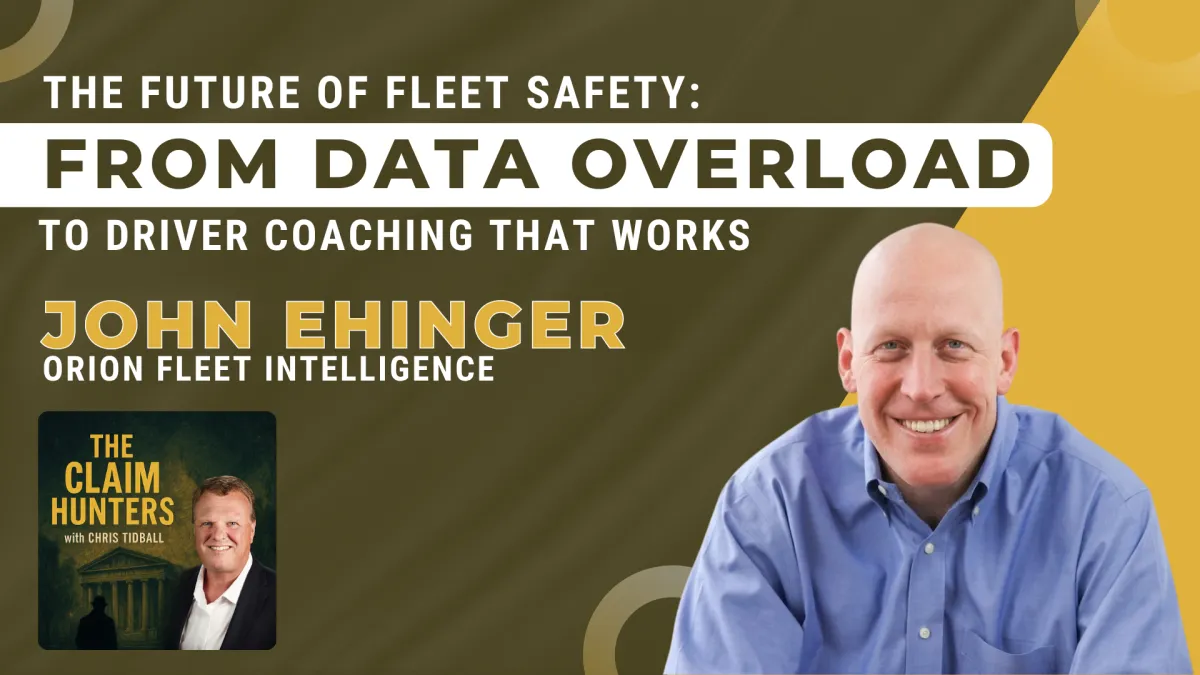
68 - The Future of Fleet Safety: From Data Overload to Driver Coaching That Works
Transforming Commercial Fleet Safety: Overcoming the Auto Insurance Crisis Through Actionable Telematics
In the latest episode of The Claim Hunters Podcast, host Chris Tidball sits down with John Ehinger, CEO of Orion Fleet Intelligence, to dismantle the operational hurdles driving the decade-long commercial auto insurance crisis. As double-digit rate increases and deteriorating loss ratios force carriers and business owners into a corner, traditional passive risk management is no longer viable. This high-level conversation explores how transitioning away from basic data collection toward targeted, insurance-linked driver coaching can dramatically reduce accident frequency, optimize claims outcomes, and insulate business operations from the rising threat of severe litigation and social inflation.
Mitigating Fleet Risk: Advanced Driver Coaching, Speed Reduction, and Alternate Data Models
The commercial auto insurance marketplace is caught in a severe financial bottleneck, defined by rising claim severities and an aggressive plaintiff bar that leverages telemetry gaps to secure massive jury awards. John Ehinger emphasizes that while traditional telematics hardware is widespread, up to 30% of devices in a standard fleet portfolio sit unplugged or unmonitored, resulting in massive data overload without driving any actual behavioral modification. Blanket metrics like harsh braking are frequently inaccurate if they fail to calculate vehicle weight or driving context, which frustrates fleet managers and alienates drivers. To combat this operational friction, insurance organizations must partner with plug-and-play platforms that seamlessly integrate into existing systems and distill raw metrics into clear, structured coaching opportunities rather than punitive administrative audits.
To structurally lower loss frequency and protect underwriting profitability, risk management strategies must prioritize speed reduction as the single most predictive lever for safety improvement. Data indicates that cutting habitual speeding incidents by half yields an immediate 30% reduction in overall accident frequency, directly mitigating the catastrophic personal injury claims that lead to nuclear verdicts. Achieving this baseline shift within a standard 90-day window requires active, context-based driver feedback rather than basic scorecard monitoring, transforming telematics from a passive recording device into an active risk-taming tool. Furthermore, for a small to mid-sized fleet lacking a dedicated safety department, deploying a managed data model functions as a virtual risk manager, establishing deep operational transparency that protects the driver while safeguarding corporate assets.
From a subrogation and financial recovery standpoint, meticulous telematics documentation provides the concrete, empirical evidence necessary to expedite third-party liability investigations and maximize recovery potential when a collision occurs. Every dollar saved in direct losses can translate to $1.67 in premium savings, giving proactive fleet operators substantial financial leverage to negotiate superior rates and terms during policy renewals. Because widespread autonomous vehicle adoption remains at least a decade away for the small fleet demographic, managing human driver behavior remains the definitive factor in controlling total cost of risk. By establishing unified safety cultures, standardizing device compliance checks, and leveraging usage-based insurance discounts, commercial operators can successfully lower their combined ratios and ensure long-term stability in a volatile marketplace.
About John Ehinger
John Ehinger is the CEO of Orion Fleet Intelligence. With a deep background in operational leadership and technology-driven risk management, he specializes in building strategic insurance partnerships, translating complex fleet telematics data into actionable business workflows, and developing data-backed driver safety programs that lower claims severity.
About Orion Fleet Intelligence
Orion Fleet Intelligence provides advanced, insurance-driven telematics and driver coaching solutions designed to improve safety and operational efficiency for commercial fleets. The company specializes in translating raw data into clear, prioritized insights, helping carriers and fleet operators reduce accident frequency, manage claims litigation risk, and optimize insurance costs.
Links mentioned in this episode
Guest Company: Orion Fleet Intelligence
Guest LinkedIn: John Ehinger
Key Episode Highlights
The Telematics Paradox: Why simply installing tracking hardware fails to reduce risk and how inactive devices lead to severe claim leakage.
The Physics of Speeding: Analyzing the direct mathematical correlation between a 50% reduction in speeding duration and a 30% drop in collision rates.
The Virtual Risk Manager: How small and mid-sized fleets can leverage external data analysis to compete with the safety infrastructure of major corporations.
Leveraging the Data for Defense: Utilizing calibrated GPS and telemetry records to counter aggressive plaintiff-side arguments and nuclear verdict exposure.
The Premium Multiplier: Understanding the structural ROI where direct loss reductions translate into major insurance premium savings and carrier discounts.
Conclusion
Navigating the future of commercial auto risk demands a deliberate shift from static data accumulation to active behavioral modification. As this discussion demonstrates, the fleet operators and insurance carriers that successfully conquer rising claims costs will be those that standardize device deployment, focus relentlessly on speed reduction, and use advanced data analytics to enhance the driver-manager relationship.
Ready to step up your claims strategy? Visit ChrisTidball.com for resources that will sharpen your edge and help you lead in today’s fast-changing insurance landscape. And if you’ve got insights or experience to share with the industry, apply here to be featured on The Claim Hunter podcast.


