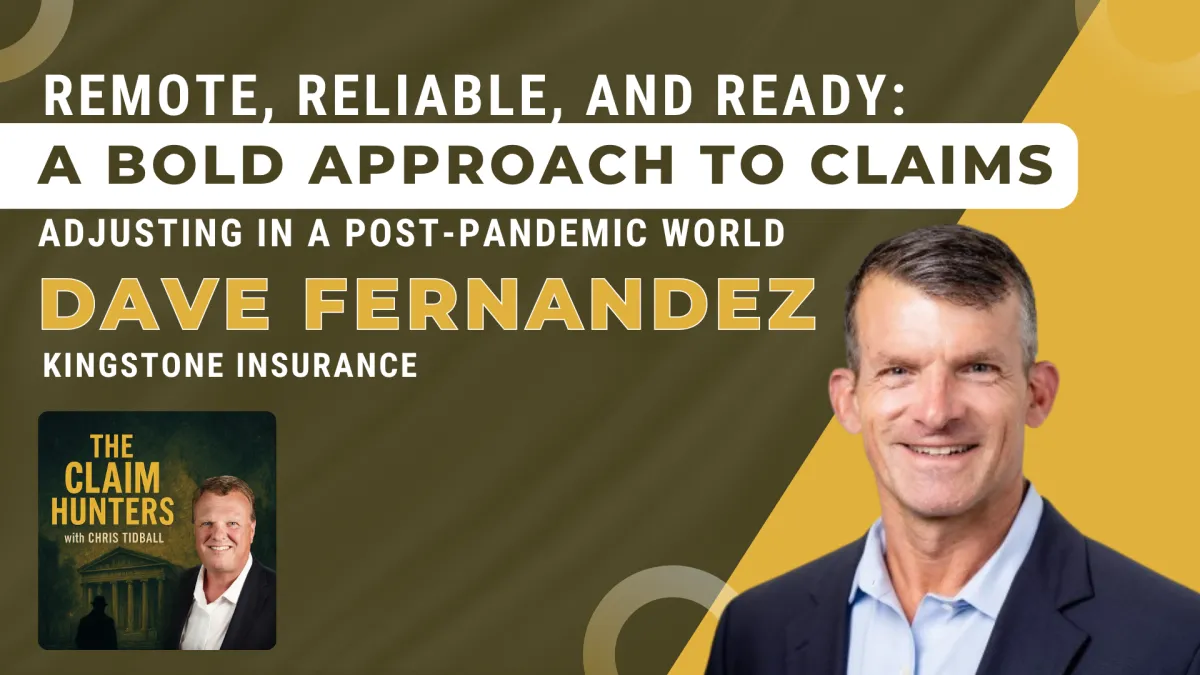
65 - Remote, Reliable, and Ready: A Bold Approach to Claims Adjusting in a Post-Pandemic World
The Evolution of Claims Adjusting: Balancing Specialized Expertise and Human Intuition
In the latest episode of The Claim Hunters Podcast, host Chris Tidball sits down with Dave Fernandez, Chief Claims Officer at Kingstone Insurance, to break down the profound shifts reshaping the property and casualty sector. Drawing from over three decades of industry experience, Dave provides executive leadership with a clear view of how claims environments have migrated from holistic, end-to-end management to highly specialized task delegation. This strategic conversation highlights how modern insurance organizations can navigate a permanently remote workforce and integrate generative artificial intelligence while preserving the critical adjuster attributes of curiosity and policyholder care.
Redefining the Modern Adjuster Workflow: Talent, Autonomy, and Augmentation
The structural transition within property and casualty operations has moved carriers away from the traditional "generalist" model, where a single claims professional managed a file through its entire lifecycle, to a heavily fragmented, task-based specialist approach. While this specialization drives operational speed, it introduces severe friction by diluting an adjuster's sense of file ownership and disrupting the direct human connection with the policyholder. To counteract this fragmentation, forward-thinking claims departments must actively design workflows that encourage specialists to maintain a holistic overview of the asset's recovery lifecycle. Facilitating cross-functional case reviews and broad technical training ensures that frontline personnel remain engaged, reducing file leakage and closing the loops that adversarial plaintiff attorneys frequently exploit.
Compounding this structural shift is the rise of the permanently remote office environment, a model that expands access to nationwide talent pools but demands a complete overhaul of legacy management metrics. Executive leaders must transition away from high-pressure micromanagement and instead establish clear, outcome-based productivity expectations supported by manageable caseload allocations. Overloading remote staff directly fuels burnout and premium turnover, making employee retention a critical challenge that hinges on corporate culture and work-life balance. When a carrier operates at a smaller scale, hiring strategies must deliberately pivot toward vetting self-motivated candidates who possess natural technical curiosity and empathy, rather than relying solely on years of experience listed on a resume.
To maximize the efficiency of these distributed teams, advanced analytics and artificial intelligence must be utilized as an assistant to human intuition, rather than a full operational replacement. Modern AI subsystems excel at parsing unstructured data, automating routine data entry, and analyzing invoices to flag deceptive billing patterns or suspicious receipts for further review. However, automated algorithms lack the qualitative data evaluation skills, situational critical thinking, and nuanced negotiation techniques that define an elite adjuster. By implementing a strict "human-in-the-loop" framework, property and casualty leaders ensure that technology handles the administrative heavy lifting, freeing skilled professionals to execute thorough investigations, secure subrogation recoveries, and provide empathetic, high-touch customer care during complex property or casualty losses.
About Dave Fernandez
Dave Fernandez is the Chief Claims Officer at Kingstone Insurance. Beginning his career in the early 1990s, he has spent decades leading high-performing claims divisions, building resilient remote workforces, and driving technological implementation strategies that prioritize both operational discipline and customer satisfaction.
About Kingstone Insurance
Kingstone Insurance is a specialized property and casualty insurance carrier providing comprehensive personal and commercial lines coverage. The company is recognized for its focused regional footprint, dedication to independent agent networks, and disciplined approach to risk management and claims resolution.
Links mentioned in this episode
Guest Company: Kingstone Insurance
Guest LinkedIn: Dave Fernandez
Key Episode Highlights
The Generalist vs. Specialist Rift: Analyzing how discrete task assignment can lead to a loss of file ownership and how carriers can rebuild total claim accountability.
Hiring for Technical Curiosity: Strategic interviewing techniques designed to identify self-motivated, inquisitive remote adjusters who look past surface data.
Workload-Driven Retention: Why managing caseload saturation is the most critical factor in reducing adjuster turnover and preserving institutional training.
AI Subsystem Constraints: Understanding the boundary where automated document parsing must stop and human negotiation and intuition must take over.
Fulfillment in Claims Resolution: Redefining claims adjusting as a highly rewarding, essential profession centered around restoring lives and protecting the combined ratio.
Conclusion
The transformation of the claims management space requires a sophisticated equilibrium between tech-driven automation and deep professional advocacy. As this discussion demonstrates, the carriers positioned to dominate the modern insurance marketplace will be those that view advanced AI tools as an operational teammate, establish cultures of true file ownership, and actively protect the well-being and technical growth of their frontline adjusters.
Ready to step up your claims strategy? Visit ChrisTidball.com for resources that will sharpen your edge and help you lead in today’s fast-changing insurance landscape. And if you’ve got insights or experience to share with the industry, apply here to be featured on The Claim Hunters Podcast.


