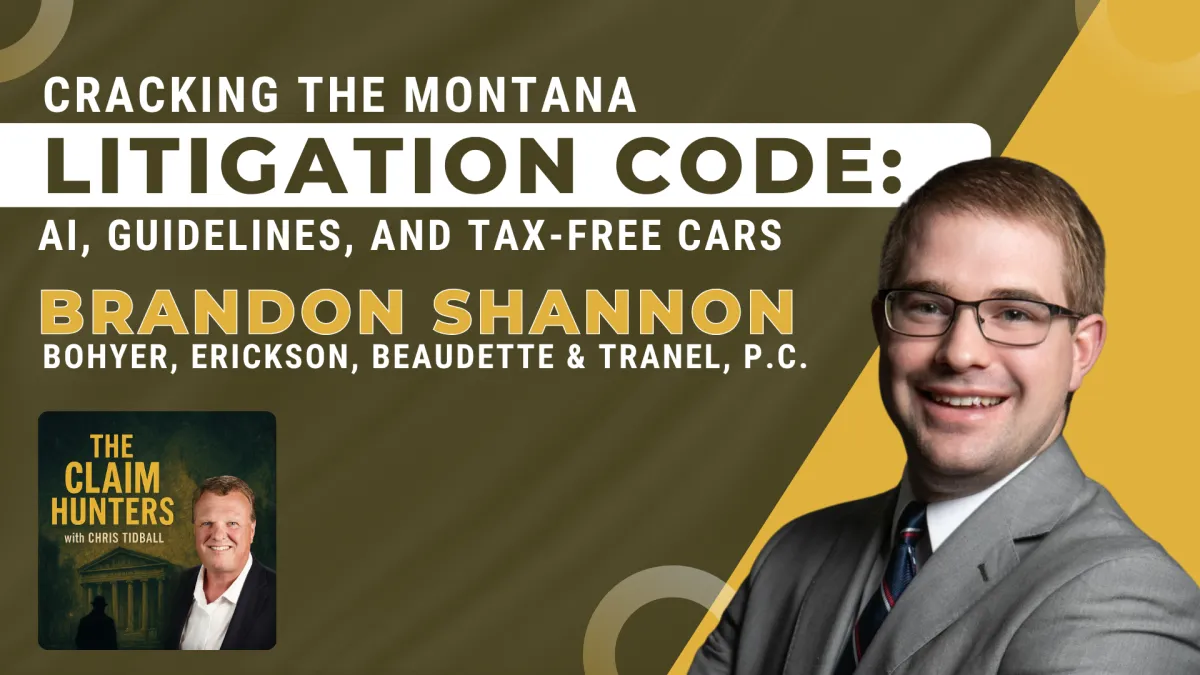
58 - Cracking the Montana Litigation Code: AI, Guidelines, and Tax-Free Cars
Navigating Litigation Complexity in Montana: Insights from Brandon Shannon
In the latest episode of The Claim Hunters Podcast, host Chris Tidball sits down with Brandon Shannon, an attorney at Boyer, Erickson, Beaudet and Well, to dive deep into the specific challenges of managing litigation in the Big Sky State. From navigating the notorious "made whole" rule to the strategic integration of AI in legal workflows, this conversation provides a masterclass for claims professionals and defense counsel. Listeners will gain a clear understanding of how to balance Montana’s unique legal landscape with the universal need for early case resolution and standardized reporting.
Optimizing Case Outcomes through Early Evaluation and Efficiency
The legal environment in Montana presents a unique hurdle for subrogation professionals known as the "made whole" rule, which dictates that an insurer cannot recover costs until the insured is fully compensated for all losses, including attorney’s fees. This high threshold often makes subrogation a non-starter unless the recovery is substantial enough to clear every dollar of the plaintiff’s damages and legal costs. Brandon Shannon emphasizes that because of this, initial strategy must focus on meticulous documentation and early communication with plaintiff's counsel to gauge whether a "made whole" status is even achievable before committing resources to recovery efforts.
To stay ahead of rising litigation costs, Brandon suggests that the most effective strategy is a structured early case evaluation, ideally completed within 45 to 60 days of file assignment. This window is the "sweet spot" for defense attorneys to move past superficial assessments and conduct a thorough review of liability, discovery, and medical records. By setting firm deadlines for these evaluations within litigation guidelines, insurers can identify cases ripe for early settlement or mediation, preventing the unnecessary accumulation of legal fees and administrative burdens that come with protracted disputes.
A significant pain point for many law firms is the lack of standardized litigation guidelines among different carriers, which often leads to administrative overload and inconsistent results. Standardizing expectations—such as uniform report formats and realistic discovery deadlines—allows attorneys to spend less time on procedural minutiae and more time on high-level legal strategy. When adjusters and attorneys collaborate to streamline these processes, the result is a more predictable, data-driven approach to litigation that improves benchmarking and leads to better quality control across the board.
About Brandon Shannon
Brandon Shannon is an experienced attorney at Boyer, Erickson, Beaudet and Well, based in Montana. He specializes in defense litigation, insurance law, and subrogation, helping clients navigate complex state-specific statutes while maintaining a focus on efficient, early-resolution strategies.
About Boyer, Erickson, Beaudet and Well
Boyer, Erickson, Beaudet and Well is a premier Montana-based law firm providing comprehensive legal services in insurance defense, personal injury, and commercial litigation. The firm is known for its deep local expertise and its commitment to utilizing modern technology to deliver efficient, results-oriented legal representation.
Links mentioned in this episode
Guest Company: Boyer, Erickson, Beaudet and Well
Guest LinkedIn: Brandon Shannon
Key Episode Highlights
The "Made Whole" Hurdle: Why subrogation in Montana requires a different strategic lens than most other jurisdictions.
The 45–60 Day Rule: A framework for initial case evaluation that ensures thoroughness without sacrificing speed.
AI-Driven Litigation: How law firms are using AI to categorize voluminous medical records and summarize depositions while maintaining human oversight.
The Standardization Gap: The critical need for uniform litigation guidelines to reduce administrative burnout for panel counsel.
Montana’s Registration Quirk: A look at the state's unique vehicle registration benefits and the "Montana LLC" strategy.
Conclusion
Navigating the legal intricacies of Montana requires a blend of local expertise and modern efficiency. This conversation highlights that while local rules like the "made whole" statute create challenges, a commitment to early evaluation, standardized reporting, and the smart adoption of legal technology can lead to significantly better outcomes for insurers and their counsel.
Ready to step up your claims strategy? Visit ChrisTidball.com for resources that will sharpen your edge and help you lead in today’s fast-changing insurance landscape. And if you’ve got insights or experience to share with the industry, apply here to be featured on The Claim Hunter podcast.


